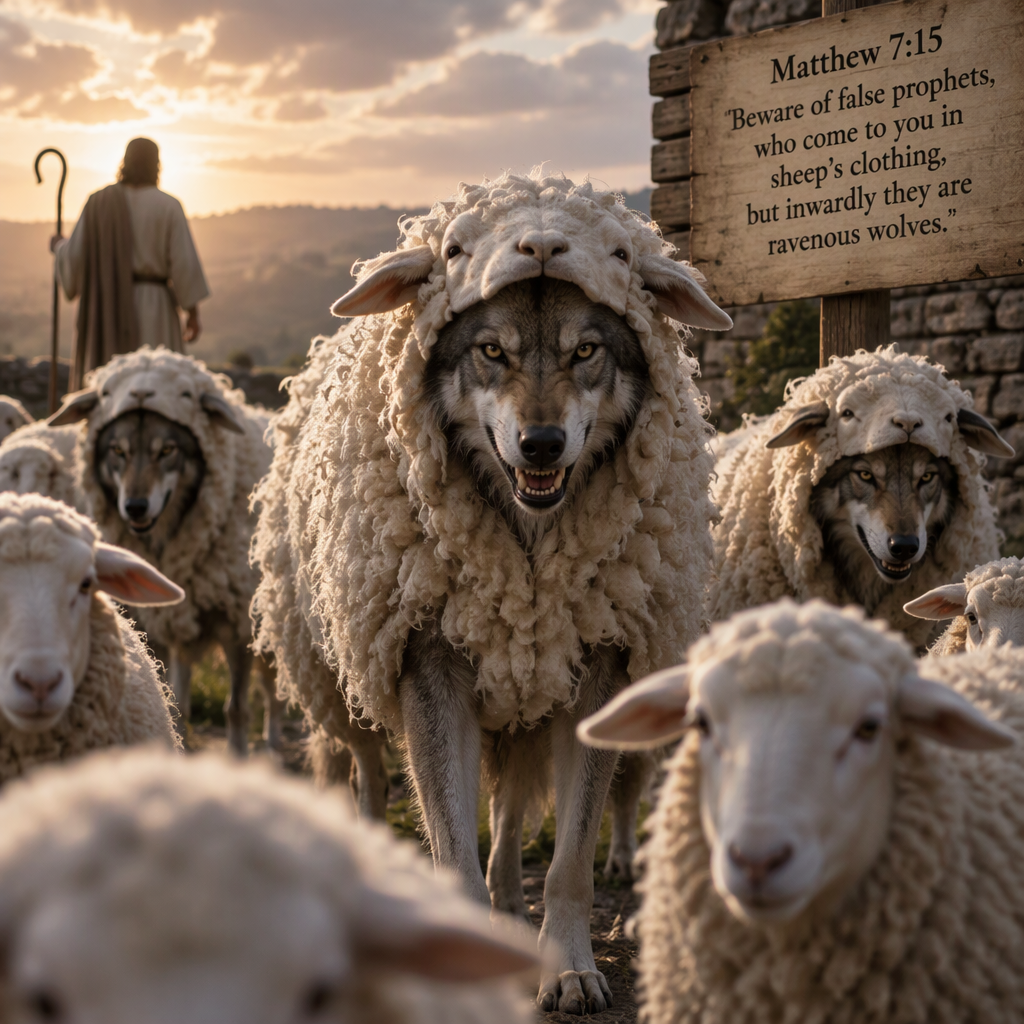
Matthew 7:15 Beware of false prophets, who come to you in sheep’s clothing, but inwardly they are ravenous wolves.
Like all the apostles after Jesus, Jude was deeply concerned with false teachers slipping into the Church and twisting the truth of the Gospel. This is the reason for his change in direction—from wanting to write about our common joy in our shared salvation to feeling compelled to write about protecting the truth of the Gospel itself. Jude knew that a corrupted message produced a distorted salvation.
Jude was highly aware of the stealthy infiltration of false teachers into the early church. As a leader, it was within his authority—and his responsibility—to warn believers who were unaware of the spiritual “spies” among them whose only intent was to twist the Gospel. They perverted the Gospel by teaching that because God forgives sin, immorality—including sexual lewdness—were acceptable lifestyles for believers. These false teachers would prey on the minds of the early believers and new converts, whose faith was still growing and had not yet taken root in their hearts. Teaching them to deny that a risen Jesus had the authority to set moral standards for their lives. Because he was well-versed in the Old Testament, he knew the fate awaiting such false teachers when he wrote in verse 4, “The condemnation of such people was recorded long ago.”
What Jude writes in verses 5-7 shows that the human mind has not changed since the beginning of mankind. And this means that since human nature has not changed, neither has God’s judgment. In verse 5 he writes: “I will therefore put you in remembrance though you once knew this, how that the Lord, having saved the people out of the land of Egypt, afterward destroyed them that believed not” This was a stark reminder to his readers that the sin of unbelief leads to eternal separation from God.
In verse 6 Jude turns to the disobedient angels: “And the angels which kept not their first estate, but left their own habitation, He hath reserved in everlasting chains under darkness, unto the judgment of the great day.” These angels rejected God’s authority and sealed their own fate. Here Jude is showing that if God’s celestial beings will receive punishment on judgment day for their rebellion, so will all of mankind who rebels against Him.
As believers, we must guard ourselves and our faith from the arrogance of nonbelievers and even Christians in name only—those who claim the title of Christian but do not carry themselves with Christian values. The nonbeliever can be highly influential, often boasting of their own abilities and even mocking God. Because of their lack of understanding, they reject the thought of being judged by a higher authority, choosing instead to create their own moral standards—following their own moral compass. Their aim is to make the believer self-conscious, even embarrassed about their faith, targeting us when emotions are high and circumstances are difficult. In those vulnerable moments, believers can become entangled with nonbelievers just as many Israelites did in antiquity.
Those who claim to follow Christ but walk in the flesh and not the Spirit can be even more dangerous than those that deny God altogether. This is because the Christian in name only often has a seductive tongue, using phrases such as “thanks to my Lord and Savior” or “by the grace of God” when speaking with believers who trust their word at face value. They are highly manipulative and self-seeking, and have no shame about using the Lord’s name in vain with unsuspecting believers who are sincere in their walk with Christ. This type of false believer is often a prime target of false teachers and evil spirits to use as an object of contention, and to even cast doubt about the faith of a true believer.
Just as it was in Jude’s day, false teachers and nonbelievers who mock the faith are unavoidable. Jude knew this, and in verse 9 he gives the example of Michael the Archangel disputing with the devil over the body of Moses. Michael did not insult or condemn the devil; instead, he simply said “The Lord rebuke you.” In a similar manner, when we as believers are being attacked by those the evil one works through, we are to show restraint. We do not repay insult with insult, and we do not raise our voices to match theirs. We stand firm in our faith and walk away, knowing that those who oppose God bring judgment on themselves, for “vengeance is Mine; I will repay, saith the Lord” (Romans 12:19).