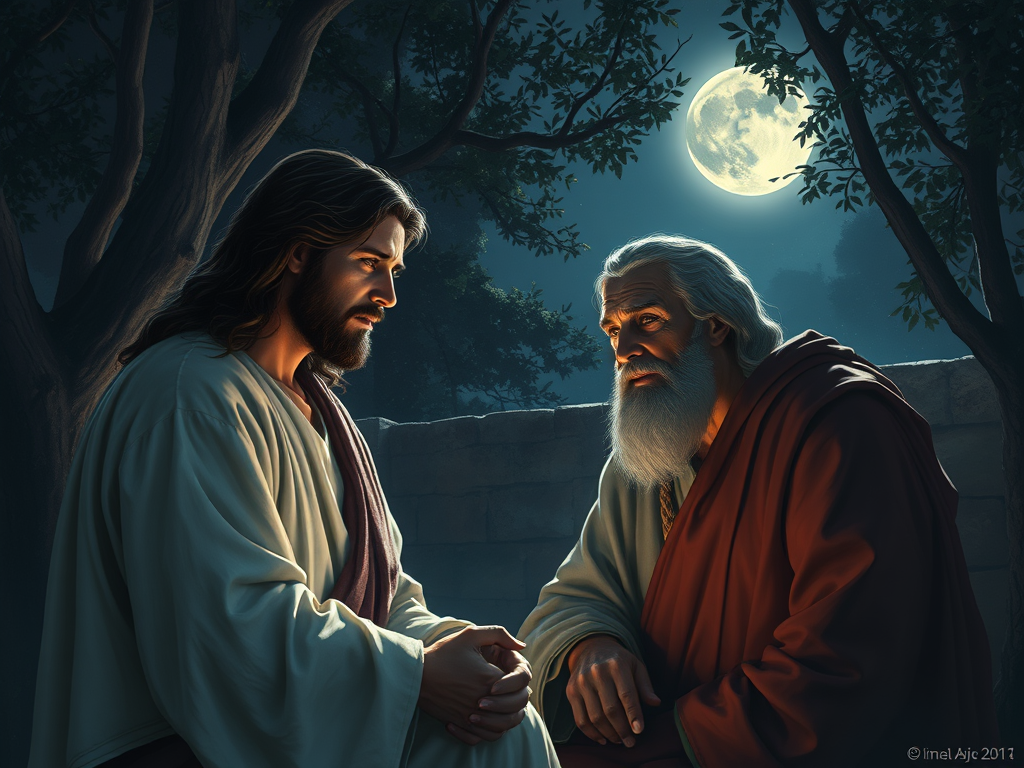
3. Jesus answered, and said unto him, Verily, verily I say unto thee, except a man be born again, he cannot see the kingdom of God.
4. Nicodemus saith unto Him, How can a man be born when he is old? Can he enter the second time into his mothers womb, and be born?
5. Jesus answered, Verily, verily I say unto thee, except a man be born of water and the spirit, he cannot enter into the kingdom of God.
Common Misunderstandings About Being Born Again
If you ask a Christian if they have been born again, most will quickly answer yes. But if you ask them how do they know they’ve been born again, the answers vary. Some point to being raised in church or believing in God. Others mention being baptized or having accepted Jesus Christ as Lord and Savior. Some may even point to the promise in Scripture of eternal life. There is nothing wrong with these answers as expressions of faith — but are any of them proof of being born again?
Being born again is one of the most misunderstood aspects of Christian life. And like most things that are misunderstood, it is often taken for granted. This should concern every self-proclaimed Christian, because Jesus made it unmistakably clear in John 3:3 (NIV): “Very truly I tell you, no one can see the kingdom of God unless they are born again.” There is nothing confusing about that statement. There is no reason to over-complicate it by cherry-picking doctrines about law and grace, or faith and salvation.
So what exactly does it mean to be born again? How can a person know with certainty that they have been born again? And perhaps the most sobering question of all: am I truly right with God if I cannot answer these questions?
Although the concept of being born again sounds simple to understand, not even some of the most learned religious leaders and teachers — in the days of Jesus or today — are able to comprehend it with a surface level reading of the text. So there is no reason to feel as if you are failing in your faith, if you don’t understand it.
Nicodemus: A Religious Man Still in the Dark
John 3 introduces us to Nicodemus, a Pharisee. According to the first-century historian Josephus Flavius, there were 6,000 Pharisees during the time of Jesus’ earthly ministry. They prided themselves on separation from Gentile influence and held a strict adherence to the Mosaic law. They were experts in the Torah, many knowing it by heart. Most Pharisees were landowners, businessmen, and synagogue leaders — respected, educated, and morally disciplined.
But Nicodemus was not just any Pharisee. He was a member of the Sanhedrin, the highest Jewish ruling council — the closest equivalent to a Supreme Court. The Sanhedrin was led by the high priest and composed of chief priests, elders, scribes, Pharisees, and Sadducees. It held authority over Jewish religious, civil, and criminal matters. It was the Sanhedrin that held a sham trial — a kangaroo court — to condemn Jesus before His crucifixion.
Yet, even with expert knowledge of the Torah and the prophets, Nicodemus still could not comprehend what Jesus meant when He said, “except a man be born again, he cannot see the kingdom of God.” But, when we look deeper into the text, we discover not only why Nicodemus was confused, but why many Christians today are as well.
The Dual Meaning of Anōthen — Again or From Above?
In John 3:3, the phrase “born again” is translated from the Greek gennēthē anōthen. Gennēthē comes from the root verb gennáō, which means ” to beget” or “to give birth to.” The word anōthen carries a dual meaning. One meaning is again, and it can also mean from above. It is not entirely clear why Nicodemus interpreted Jesus’ words to mean “born again,” especially when Jesus immediately connected the phrase to “see the kingdom of God.” It is also noteworthy that John makes no attempt to clarify the meaning for his readers. The most reasonable explanation is that John assumed his audience would understand that Jesus meant born from above.
John uses the term anōthen in other passages, and he always uses it to mean “from above“. In John 19:23 when describing Jesus’ coat, he writes that is was woven “from the top throughout.” And in John 3:31 he declares, “He who comes from above, is above all.” John consistently uses anōthen to mean “from above,” not “again.”
Jesus’ Patience With Nicodemus’ Confusion
A lesson we can learn from Jesus in this dialogue is the remarkable patience He showed toward Nicodemus. Despite Nicodemus’ expert knowledge of the Torah and the prophets, he was utterly confused by what Jesus was saying. Asking — “Can he enter the second time into his mother’s womb?” — was illogical and beneath the intelligence and training of a member of the Sanhedrin. As He often did with other Pharisees, Jesus did not rebuke Nicodemus. Instead, He simply and patiently said with clarity, “except a man be born of water and the spirit, he cannot enter into the kingdom of God.” This statement should have made what Jesus meant, absolutely clear to Nicodemus.
“Born of Water and Spirit” — A Prophecy Nicodemus Should Have Known
With his knowledge of the prophets, Nicodemus should have immediately recalled Ezekiel 36:25-27 where God promises Israel a future cleansing and spiritual renewal:
25. “I will also sprinkle clean water on you, and you will be clean. I will cleanse you from all your impurities and all your idols.
26. I will give you a new heart and put a new spirit within you; I will remove your heart of stone and give you a heart of flesh.
27. “And I will put My Spirit within you and cause you to walk in My statutes and to carefully observe My ordinances.
Jesus had not made a new revelation to Nicodemus. The promise of spiritual rebirth — cleansing, regeneration, and the indwelling of God’s Spirit — had been given to Israel centuries earlier. In seeking righteousness through the law, and his prominent religious status, it seems Nicodemus had forgotten the very prophecy that explained what Jesus meant. Being “born of water and the Spirit” was not a new idea; it was the the prophesied work of redemption that would cleanse God’s people, renew their hearts, and restore glory to His name.